
Why Do Cats Sleep So Much? What Your Cat’s Rest Habits Tell You
The question I get asked constantly by new cat owners: “Is it normal that my cat sleeps all day?” In almost all cases, yes — it’s not only normal, it’s biologically appropriate. But the specifics of how, where, when, and for how long a cat sleeps carry meaningful information about their health and wellbeing that every owner should understand.
The Biology of Cat Sleep: Why So Much?
Adult cats sleep between 12 and 16 hours per day on average, with kittens and senior cats often sleeping more. This seems excessive by human standards but makes perfect sense given the feline metabolic strategy. Cats are built for short, intense bursts of predatory activity — the stalk, the chase, the pounce. These activities are energetically expensive and require peak physical and neurological condition. In between these bursts, extended rest conserves energy and allows physical recovery. Wild cats operate this way: a lion may rest for 20 hours on a given day, then expend tremendous energy in a hunting effort.
Domestic cats carry this biology unchanged by thousands of years of domestication. The predatory burst that once chased a vole now chases a feather toy, but the energy expenditure pattern is the same. Extended rest is not laziness; it’s the other side of the energy economy that allows for effective bursts of activity.
The Crepuscular Reality
Cats are crepuscular — most naturally active at dawn and dusk, when their primary prey is also most active. This is why many indoor cats are most alert and energetic in the early morning and in the evening hours. This explains the phenomenon of “zoomies” at 3 AM — the cat isn’t being deliberately disruptive. They’re experiencing a natural activity peak at the time their biology schedules it.
Understanding this helps with management. An evening play session that tires the cat out before your bedtime, followed by feeding (mimicking the hunt-then-eat sequence), shifts the activity peak effectively for most cats. The goal isn’t eliminating the cat’s natural rhythm; it’s aligning it better with your household’s schedule.
Types of Cat Sleep
Cats have two main sleep states, and distinguishing them tells you something about the cat’s comfort level and recovery state.
Light sleep (dozing): The cat is resting but easily roused. Ears may swivel toward sounds, eyes may open at a slight noise. This state dominates most of the cat’s rest time and accounts for the bulk of those 12-16 hours. The cat can go from this state to full alertness in a fraction of a second — an evolutionary adaptation for an animal that needs to respond immediately to both prey opportunities and threats.
Deep sleep (REM equivalent): The cat is in a fully restful state. You may see whisker twitching, small paw movements, or vocalization — the behavioral signs of dreaming. This state occurs in cycles interspersed with lighter sleep. A cat who can reach and sustain deep sleep is a cat who feels genuinely safe in their environment. A chronically anxious or threatened cat often cannot reach deep sleep, with significant effects on physical and psychological health over time.
Sleep Location as Wellbeing Indicator
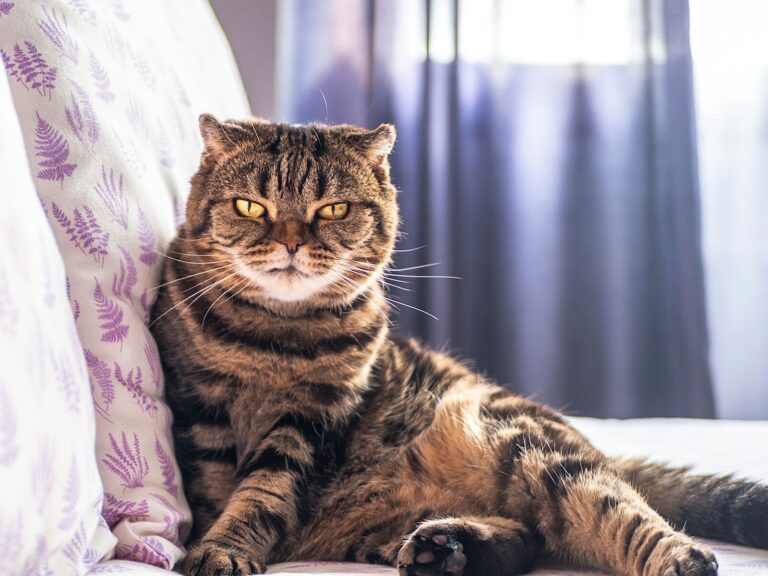
Where a cat chooses to sleep tells you a lot about how they feel. A cat who sleeps in exposed, central locations, belly up or fully sprawled, is a cat who feels completely secure. A cat who always sleeps in hidden, enclosed spaces may simply prefer that type of space — many cats do — or may be sleeping defensively out of chronic low-level anxiety. A cat who previously slept openly and now only sleeps hidden is communicating a change in comfort level worth investigating.
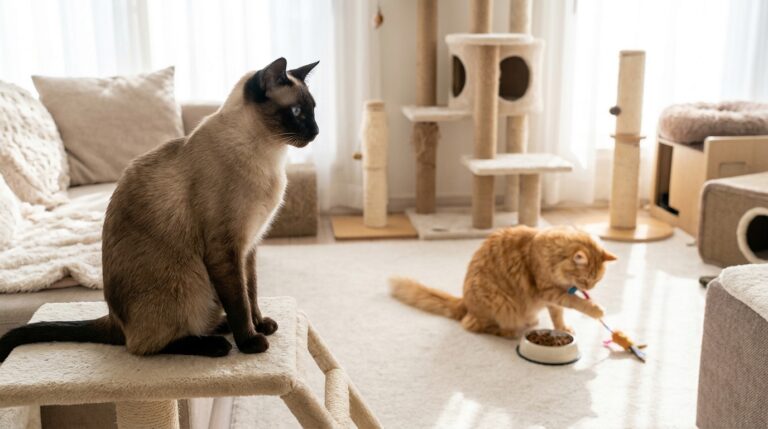
Location choices also reflect temperature preferences, social bonds (sleeping near or on family members indicates strong trust), and territorial mapping. The highest accessible sleeping spot in the room is generally preferred by the most confident cat in a multi-cat household — it’s a dominance expression built into the resting behavior.
Changes in Sleep That Warrant Attention
Baseline sleep changes are often early indicators of health changes. A cat who is sleeping significantly more than their normal, or who seems lethargic — difficult to rouse, disinterested in things that previously engaged them, moving slowly after waking — may be ill. Lethargy is one of the most consistent early signs of feline illness, and it’s distinguished from normal drowsiness by the quality of the wakefulness: a lethargic cat is not sharp and engaged when awake; a normally drowsy cat is.
A senior cat who is sleeping much more, or conversely one who is sleeping poorly and vocalizing at night, may be dealing with pain, cognitive decline, hyperthyroidism, or other age-related conditions that warrant veterinary evaluation.
Supporting Good Sleep
For most cats, supporting good sleep means providing sufficient safe sleeping spots, a predictable environment, adequate daily exercise and mental stimulation (so the cat arrives at rest genuinely tired rather than under-exercised), and appropriate temperature. A cat who can’t find a warm, private resting spot in a household with dogs or disruptive children may be sleep-deprived even if they seem to be lying down frequently. Access to quality uninterrupted rest is a genuine welfare need, not a luxury, and protecting it is part of responsible cat ownership.