Training Multiple Cats in One Household: Managing the Beautiful Chaos
I work with a lot of multi-cat households, and I’ll tell you honestly: they can be deeply rewarding or genuinely stressful, and which one it is depends enormously on how the household is set up and managed. Two cats who are well-matched, properly introduced, and living in an adequately resourced environment can provide each other with enrichment, play, and companionship that a single cat simply can’t get. Two cats who are mismatched, poorly introduced, or resource-competing are a constant source of stress for both cats and their owners.
The Foundation: Adequate Resources
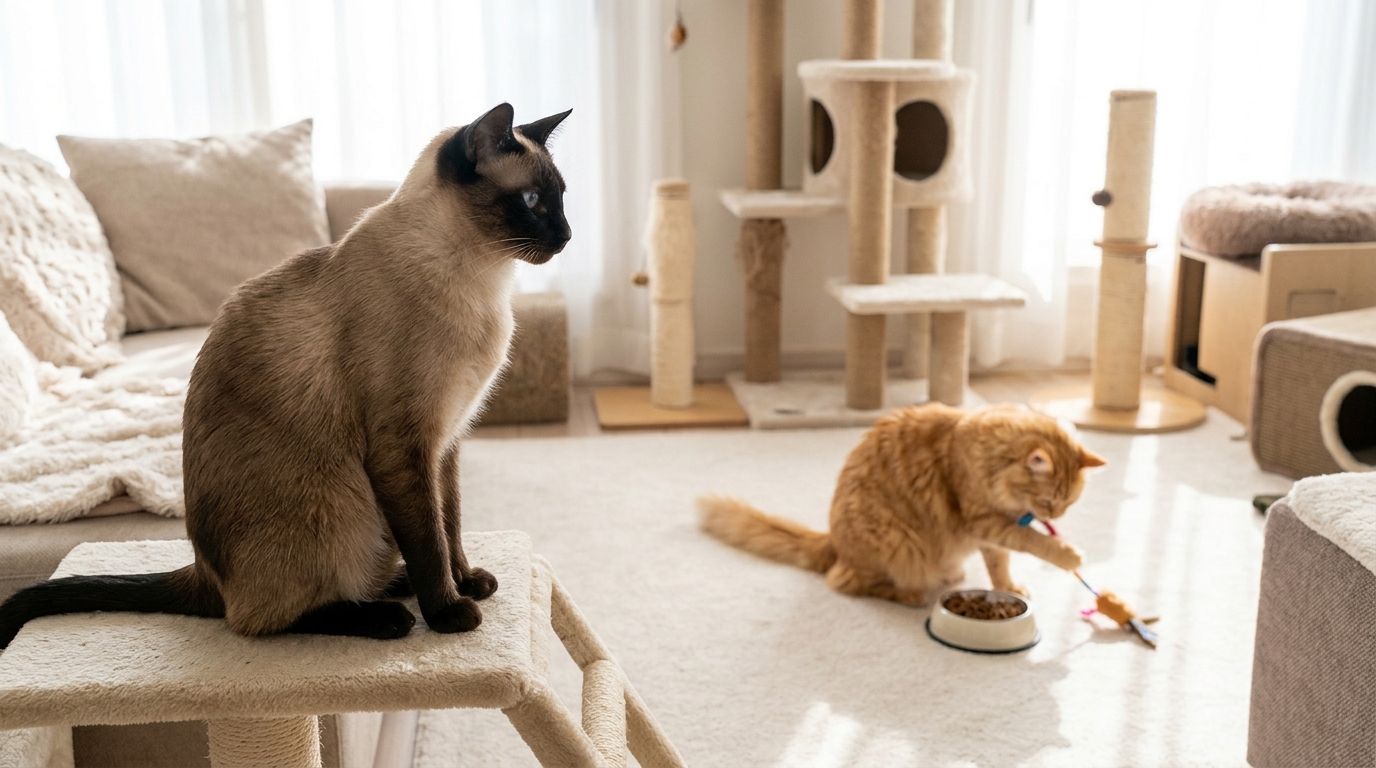
Every problem in a multi-cat household can be traced, at least partially, to resource availability. Resources in the feline sense aren’t just food and water — they include litter boxes, resting spots, elevated positions, hiding places, and access to human attention. The rule is simple: provide resources in excess of the number of cats, distributed throughout the home in locations that prevent any one cat from controlling access.
Specifically: one litter box per cat plus one extra, in different locations. Multiple feeding stations — ideally separated enough that cats don’t have to eat within sight of each other if they’re not comfortable doing so. Multiple high perches and resting spots so that vertical territory is genuinely distributed. Multiple retreat spaces where any cat can be alone and unobserved.
Inter-Cat Social Dynamics
Cats are not naturally the group-living species that dogs are. In the wild, cats are largely solitary hunters who share territory based on resource availability — cats in the same area know each other but don’t typically rely on social group membership the way dogs do. Domestic multi-cat living asks cats to do something that’s not entirely natural to them, and it works best when the cats have compatible personalities and adequate individual resources.
Social compatibility is not just about cats “getting along” in the absence of fighting. Real compatibility involves genuine neutrality or positive engagement — cats who share space comfortably, groom each other, sleep together, or play together. Cats who merely tolerate each other with minimal conflict while maintaining complete distance are managing, not thriving. Cats who are in chronic low-level tension — one following the other, one blocking access to resources, subtle bullying behaviors — are in a welfare situation that needs attention.
Reading Inter-Cat Relationships
Signs of healthy inter-cat relationships: mutual grooming, sleeping in contact or in proximity, play without one cat constantly being the aggressor, comfortable sharing of space. Signs of tension: one cat consistently avoiding another, one cat monitoring and following another, access blocking at food bowls, water sources, or litter boxes, ambushing, and displacement behaviors (one cat moving from a spot when another approaches).
If tension patterns are present, the first intervention is resource augmentation — more boxes, more feeding stations, more resting spots. Often this alone resolves the competition-based tension. If behavioral conflict persists beyond resource adjustment, a more comprehensive behavior assessment may be needed.
Individual Training in a Multi-Cat Home
Training is possible and valuable in multi-cat households, but it requires individual work. Attempting group training sessions is an exercise in frustration for everyone. Instead, train cats separately in different rooms or at different times. This allows each cat to focus without competition for treats or attention, and allows you to address each cat’s individual needs and learning pace.
Teaching cats a visual cue that training is happening — a specific mat they learn means “come here for work” — helps enormously. Each cat eventually learns their name cue and can be called for their session while others are elsewhere. With consistent practice, most cats in a well-managed multi-cat home become quite good at individual training sessions.
Introducing a New Cat to an Established Household
Introductions to an established household must be done gradually — I cannot emphasize this enough. The introduction process I described in the new cat article applies here, with the addition that you’re managing the relationship between the new cat and one or more resident cats, each of whom has their own reaction to process.
Phase the introduction through scent, then visual, then supervised physical. Don’t rush any phase. The goal is for the resident cats to reach a state of neutrality toward the new cat’s scent and presence before physical interaction occurs. A rushed introduction that goes badly often sets the inter-cat relationship in a negative direction that takes months to repair, if it can be repaired at all. A patient introduction that goes well establishes a foundation that benefits all cats for years. The extra weeks are worth taking.
The Reward of Getting It Right
When a multi-cat household works well — cats who genuinely enjoy each other’s company, who play together, who sleep in a pile, who groom each other — it’s one of the most delightful living arrangements I know. Cats enrich each other in ways their human owners simply cannot. Play partners, grooming partners, social warmth in ways that matter genuinely to them. Getting the foundation right makes all of that possible.