Why Cats Knock Things Over: The Real Psychology Behind It
Few cat behaviors generate as much theatrical exasperation from owners as the deliberate, slow-motion push-off-the-table. The cat makes eye contact. Puts one paw on the object. Holds eye contact. Slowly pushes. Watches it fall. Walks away. It looks impossibly calculated. And while the full picture is more complex than pure spite, there are genuine behavioral reasons for this behavior that are worth understanding.
Paw Investigation: The Primary Driver
Cats have highly sensitive paw pads loaded with sensory receptors. Pawing at objects is fundamentally an investigative behavior — a way to assess an object’s properties: its weight, texture, how it responds to movement, whether it might be prey. From a feline behavioral standpoint, the “knock off” is often the end point of an object investigation, not the beginning of a deliberate act of property destruction.
This is why cats will often bat at an object multiple times before actually pushing it off. They’re assessing it. The fall is interesting additional information — it moved, it made a sound, it changed state. Sensory-interesting events, which falls create, are engaging to a predatory brain wired to notice movement and change.
Attention-Seeking: The Learned Component
Here’s where it gets more sophisticated. Many cats have learned — through experience — that knocking things over produces an immediate, reliable response from humans. You shout, you rush over, you pick up the object. From the cat’s perspective, this is highly effective attention-getting behavior. If the cat is bored, understimulated, or wants interaction, and knocking something over reliably produces immediate human response, the behavior is reinforced and perpetuated.
The solution for the learned attention-seeking component is counterintuitive: ignore the behavior when you can safely do so, and increase proactive engagement before the cat needs to resort to it. A cat who gets adequate play, interaction, and enrichment doesn’t need to knock things off tables to get your attention.
Predatory Practice
Small objects that move unpredictably — pens rolling off a desk, toys on a surface — can activate predatory interest. Batting something to make it move and watching what happens is a form of prey assessment behavior. This is particularly common with small, lightweight objects that move readily when batted. It’s not aggression or destructiveness — it’s a cat being a cat, engaging their predatory curiosity with the objects in their environment.
Environmental Exploration
Kittens and young cats are particularly prone to this behavior because their environmental exploration drives are at their highest. Everything is new and worth investigating. Objects on surfaces are part of the territory, and interacting with them is part of mapping that territory. As cats mature, object-batting behavior often decreases if they have adequate environmental enrichment to satisfy their exploratory drives through other outlets.
What to Do About It
If specific objects are being targeted repeatedly, the simplest solution is removing the temptation from accessible surfaces — secure anything genuinely valuable or fragile. This isn’t admitting defeat; it’s environmental management that respects cat behavior while protecting your belongings.
For the attention-seeking component: ensure adequate daily play and interaction before the cat reaches the point of engineering ways to get your attention. A cat who has just had a satisfying play session and is well-fed and comfortable generally does not need to knock things off tables to get something to happen.
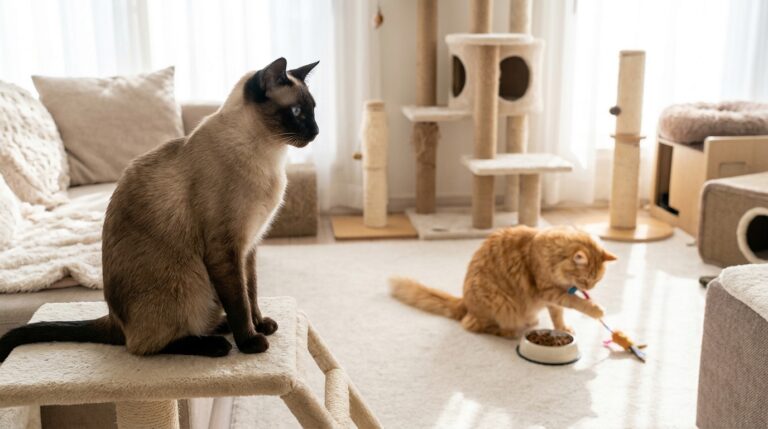
Interactive puzzle feeders and environmental enrichment placed throughout the home redirect investigative behavior to appropriate targets. A cat who has interesting things to interact with doesn’t need to repurpose your desk contents as entertainment.
Don’t reinforce the behavior with dramatic responses if it’s clearly attention-seeking. Calmly replace the object without engaging the cat, then redirect to an appropriate play toy. Consistency over time shifts the behavior.
A Note on “Deliberate” Cat Behavior
The anthropomorphic framing of “my cat does it on purpose to annoy me” is entertaining but probably not accurate to the cat’s experience. More likely, the cat has learned that this behavior produces interesting results and continues to do it for that reason. The “deliberateness” reads more as the cat following learned and instinctive routines than plotting household mischief. Understanding this makes the behavior less infuriating and more manageable — it’s a behavioral pattern with causes that can be addressed, not a character defect.