Why Does My Cat Purr? The Complete Truth Behind This Familiar Sound
Almost everyone assumes a purring cat is a happy cat. In the vast majority of cases, that’s correct — but in roughly twelve years of working closely with cats, I’ve encountered purring in contexts that tell a more complex story. Understanding the full range of what purring communicates makes you a genuinely better cat owner.
How Purring Works
First, the mechanics: cats purr through rapid, rhythmic movement of the laryngeal (voice box) muscles in coordination with the diaphragm. This produces a continuous sound during both inhalation and exhalation at a frequency typically between 25 and 150 Hz. Unlike many vocalizations, purring is sustained across the entire breathing cycle, which is why it sounds continuous and rhythmic.
The neural signal originates in the brain and triggers these muscle contractions. Interestingly, domestic cats can purr continuously, while the big cats — lions, tigers, leopards — can only purr on one part of the breathing cycle and instead produce roars. Cheetahs and smaller wild cats purr similarly to domestic cats.
Contentment Purring
The most common context: a cat who is warm, well-fed, relaxed, being stroked by someone they trust. The purr here is straightforward positive affect — something broadly analogous to a contented sigh in humans. This is the context most people think of when they think of cat purring, and it’s real and valid.
Solicitation Purring: The Strategic Purr
This is where it gets interesting. Research from the University of Sussex identified a specific type of purr that cats produce when they want something, most often food. This “solicitation purr” embeds a higher-frequency cry component within the normal purr sound — a sound that activates human caregiving instincts. Humans, even those without cats, consistently rate this purr as more urgent and less pleasant than regular contentment purring.
Cats appear to have developed this targeted communication specifically in their relationships with humans. Wild cats don’t do it with each other. It’s an evolved social tool for getting needs met from humans. After years of listening to cats, I can usually identify the solicitation purr by its slightly more insistent, more complex tone — and sure enough, it almost always corresponds to an empty food bowl or a missed meal.
Stress and Pain Purring
This surprises most people: cats sometimes purr when they are frightened, unwell, or in pain. Queens often purr while giving birth. Cats may purr at the vet while clearly showing fear signals through body language. Some cats purr during their final hours of life.
The prevailing hypothesis — and research supports this — is that purring in these contexts is self-soothing. The act of purring releases endorphins and may have a calming effect on the cat’s own nervous system. There’s also a more biomechanical hypothesis that resonates strongly with me.
The Healing Vibration Hypothesis
The frequency range of cat purring — 25 to 50 Hz — is the same frequency range used therapeutically to promote bone density and heal fractures in human medicine. Research has found that cats experience significantly lower rates of bone disease than other comparably sized mammals, and some scientists have proposed that the vibrations from purring may contribute to maintaining bone density during the long hours cats spend resting.
The practical implication of this, if the hypothesis holds, is that cats may have evolved purring partly as a “self-healing” mechanism — a low-energy activity that stimulates bone and tissue maintenance while they’re resting. It’s a hypothesis rather than a settled fact, but the anatomical evidence is intriguing. It also offers a compelling explanation for why cats purr when sick or injured — not just for emotional comfort but potentially for physical recovery support.
Learning to Read Context
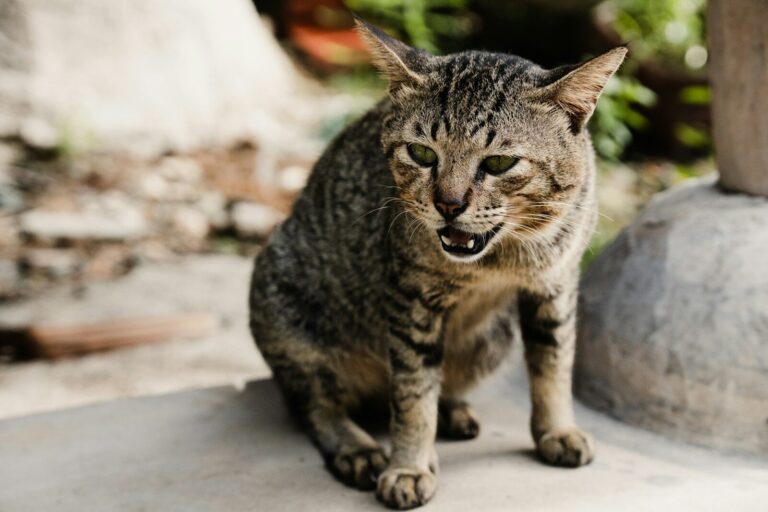
So what does this mean practically? Pay attention to the full body language picture when your cat purrs. A cat who is purring with soft eyes, relaxed body, and a loose tail is genuinely content. A cat who is purring while crouched, with tense body and slightly pinned ears, is purring under stress. A cat who is purring at their food bowl at 5:59 AM is running a very specific social manipulation on you (it works, incidentally — those embedded cries are genuinely hard to ignore).
The presence of purring tells you the cat is engaging with you or with their situation in some way. The quality and context tell you what that engagement means. In twelve years, I’ve found that paying close attention to the full communicative picture — not just one signal in isolation — consistently reveals what a cat is actually experiencing.
A Final Note: The Cats Who Don’t Purr
Not all cats purr, and not all cats purr loudly. Some cats produce a barely perceptible vibration that you can feel only by touching their chest. Some cats, particularly feral-born adults socialized later in life, may rarely purr with their human even when clearly comfortable. The absence of purring doesn’t mean the cat is unhappy. Other signals — slow blinks, head bumps, the upright greeting tail, voluntary proximity — all communicate positive affect without sound. Purring is one channel in a rich communication system; learn all the channels, and you’ll never miss what your cat is telling you.